
By Stefan Korshak
Romanian President Nicușor Dan expressed hope that Russia would strike Ukraine more precisely to avoid drones entering Romania, after a Russian Shahed hit a Galați apartment building on May 29, 2026, injuring two. He confirmed Russian responsibility but avoided criticizing Russia’s campaign. The remarks drew sharp criticism from Ukraine, while Zelensky praised Romania’s response.
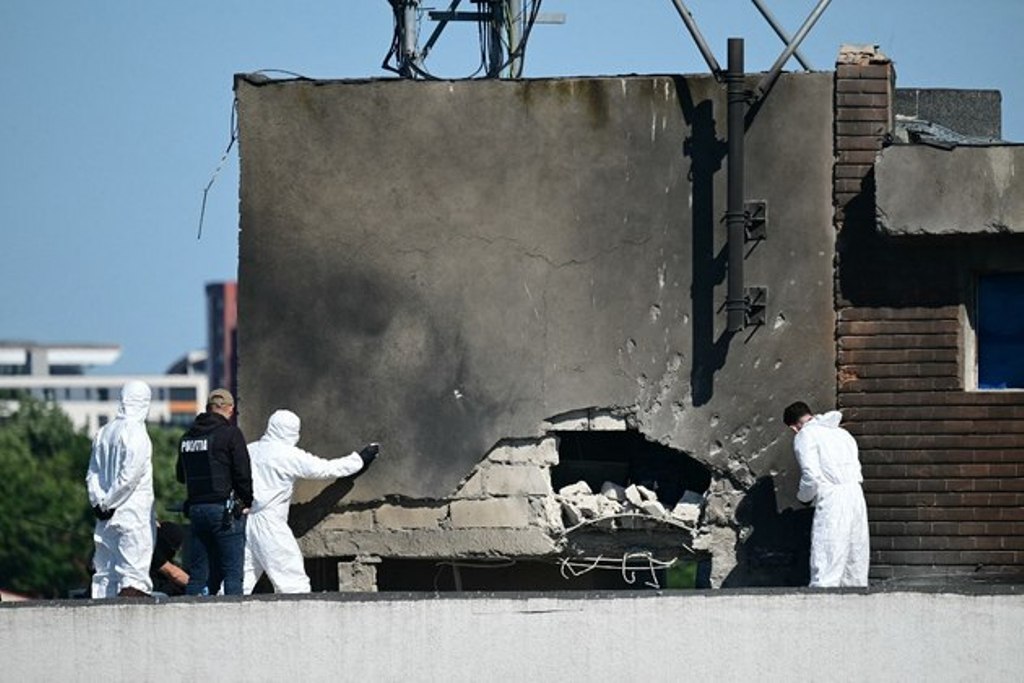
Romanian President Nicușor Dan said in an interview on Sunday that Russia must ensure its strikes on Ukraine do not endanger neighboring NATO territory after a drone entered Romanian airspace and hit a residential building.
Speaking to the BBC’s Weekend program, Dan confirmed that Russia was responsible for the Friday drone strike in the Danube port city of Galați, which injured two people, and called for greater precision in Russian attacks.
“It became dangerous for Romanian cities. When the Russians are hitting, targeting towns that are on the other side of the Danube they have to be sure they do not provoke injuries for the Romanian citizens,” Dan said. “I hope that they will stop.”
Dan did not directly criticize Russia’s continued long-range strikes on Ukraine, which have targeted cities almost daily since late 2022.
He said the incident occurred after a Russian drone was damaged by Ukrainian air defenses during an attack on the Ukrainian port city of Reni and then changed course.
“There was a swarm of 43 drones that targeted the Reni port which is a west Danube port in the Odesa region,” Dan said.
According to Ukraine’s Air Force, Russia launched one ballistic missile and at least 232 drones overnight from Thursday to Friday, targeting central and western Ukraine. Ukrainian defenses said they intercepted or suppressed 217 drones, with several reaching targets in Odesa, Izmail and Reni, damaging civilian infrastructure.
The 93 percent interception rate recorded that night is consistent with Ukraine’s air defense performance, which over more than four years of war has developed into one of the world’s most effective systems, particularly against modern threats such as kamikaze and decoy drones.
The drone that struck a residential building in Galați marked the first incident in which a Russian unmanned aerial vehicle (UAV) injured Romanian citizens. Dan said Russian drones have crossed Romanian airspace “about 20 to 30 times” since the start of the war.
Bucharest’s decision on Sunday to close the Russian consulate in the port city of Constanța, declare Consul General Andrei Kosilin persona non grata, and order him to leave the country within 72 hours is intended to push Moscow to avoid strikes on Ukraine that risk affecting Romanian territory, Dan said.
On Friday, the day the drone struck the apartment building in Galați, Romanian Brig. Gen. Gheorghe Maxim told a defense ministry briefing that Romanian forces tracked the incoming drone but were unable to intercept it due to the short time it spent in Romanian airspace and the proximity of civilian structures.
He added that Romanian forces are not permitted to fire toward Ukrainian territory, making it difficult, and in some cases impossible, to engage an approaching drone even after it enters Romanian airspace.
“The first restriction we have is legal: We cannot open fire in a way that affects the airspace of a neighboring country. Furthermore, engaging an aerial target requires a certain amount of time, which involves detection, identification and engagement. The four minutes we had at our disposal were an extremely short period of time,” Maxim said.
Romanian law, which allows the deployment of air defense systems on private property only with the owner’s explicit consent and restricts firing if it could endanger civilian property, also complicates efforts to defend NATO’s eastern flank against incoming aerial threats, he added.
Dan’s remarks, which appeared to frame Russia’s attacks as an issue of targeting accuracy rather than broader aggression, drew criticism from some Ukrainian commentators. Ihor Sushko, a Ukrainian volunteer and military blogger, reacted sharply, arguing the problem lies in Russia’s invasion itself rather than where its strikes land.
“Romanian President Nicușor Dan, the f**king idiot: Asked Russia to improve their drone targeting so they can more precisely murder Ukrainians north of the Danube river to ensure Romanians don’t suffer,” Sushko said in part.
President Volodymyr Zelensky said in a video statement that he spoke with Dan by phone after the strike on Galați, wished those injured a speedy recovery, and praised Romania’s “principled, swift, and strong” response.
At the same briefing, Romanian defense ministry spokesperson Cristian Popovici said Bucharest “cannot risk creating more threats than it can prevent,” adding that the military operates under strict legal constraints.
The comments by Maxim and Popovici echo a Romanian legal wrangle lasting more than two years, during which the Romanian military refused, on almost any terms, to fire or even to attempt to divert Russian drones violating Romanian airspace.
Officials previously said Romanian law prohibited engaging even military aircraft violating its airspace unless clear hostile intent had been established and attempts had been made to contact the pilot. This effectively made it illegal to engage unmanned drones, even those carrying warheads.
In February 2025, Romania amended its legislation to permit air defense forces to engage drones entering national airspace and posing a threat. However, restrictions remain on deploying systems on private property and using force near civilian areas.
Russia typically launches 100-200 kamikaze drones accompanied by 1-3 ballistic missiles at Ukraine nightly. Every 7-10 days, a major strike from bombers, warships and ground systems is launched, sending 500-1,000 drones and 40-80 missiles of all types at targets inside Ukraine.
In 2025 alone, Russia launched more than 100,000 drones and 2,400 missiles, according to official data.
In May 2026, Russian strikes killed at least 8 civilians and injured more than 100 in Ukraine, according to civil defense reports. In 2025, UN figures show that Russian aerial attacks killed at least 2,514 civilians and injured 12,142.
Original source: https://www.kyivpost.com/post/77290