UK Has No Defences to Stop Iranian Missiles and Would be Forced to Rely on US and Europe to Stop Them as it’s Revealed They Can Now Hit London
By GLEN OWEN POLITICAL EDITOR
Britain would be forced to rely on American missile defence systems stationed in Europe if Iran launched a rocket attack on the UK similar to the one attempted on Diego Garcia this weekend.
The warning came after Tehran fired two ballistic missiles on Friday night towards the base in the Indian Ocean, which is jointly operated by the US and the UK.
The island lies 2,360 miles from Iran, well beyond the 1,240 miles which was thought to be the outer limit of the regime’s reach.
It potentially puts Paris, 2,609 miles away, and even London – 2,750 miles – within Iran’s range if, as some strategists fear, the country uses its Simorgh space launch technology to extend its missile range. RAF Akrotiri in Cyprus is just 1,000 miles from Tehran.
And Israel warned last night that that Iran’s new missile can hit Europe.
IDF chief of staff, Lt Gen Eyal Zamir, in a video released on Saturday night. said: ‘Iran launched a two-stage intercontinental ballistic missile with a range of 4,000km towards an American target on the island of Diego Garcia.
‘The missiles were not intended to hit Israel. Their range reaches the capitals of Europe. Berlin, Paris and Rome are all within direct threat range.’ The IDF later added that London is also in range.
Steve Prest, a retired Royal Navy commodore, said: ‘Ballistic missiles are space rockets. They launch, they go really high up and they come down really fast. If you’ve got a space programme, you’ve got a ballistic missile programme.’
In a ballistic attack, defence experts say Britain would be forced to rely on American SM-3 defence systems stationed across Eastern Europe, or the Patriot missiles used by the Germans, to intercept rockets.
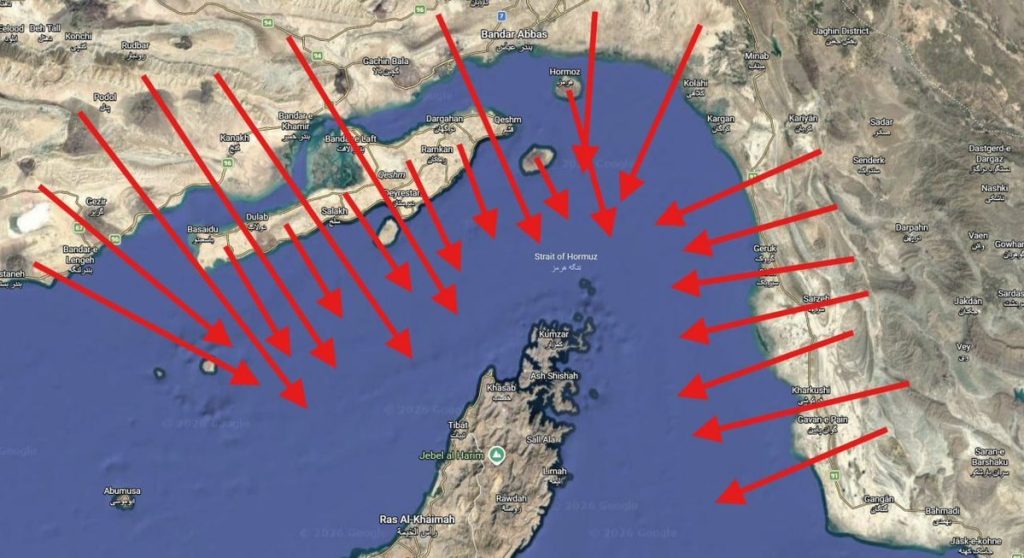
The attempted strike on Diego Garcia came as Sir Keir Starmer extended permission for the US to use British bases to launch attacks on the Strait of Hormuz to protect shipping from Iranian assaults.
Neither of the missiles fired at Diego Garcia hit their target, with one believed to have been shot down by a US warship’s SM-3 interceptor and the other failing in flight.

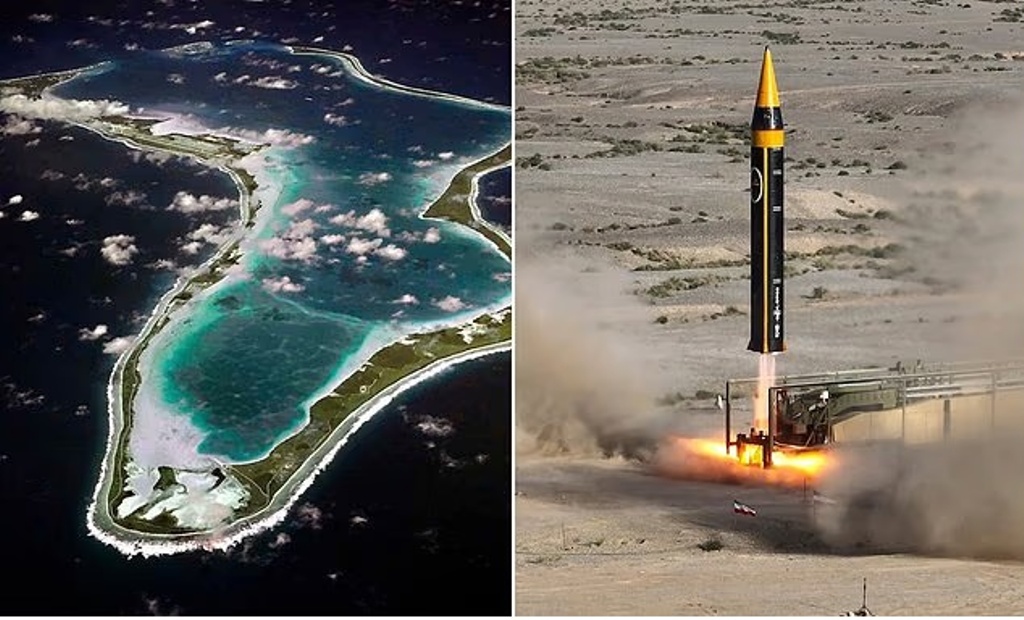
An aerial view of Diego Garcia, which faced an attempted rocket attack this weekend

A Khorramshahr-4 missile is launched at an undisclosed location in Iran
Tory leader Kemi Badenoch accused Sir Keir of covering up the attempted attack on Diego Garcia, saying the Prime Minister needed to ‘come clean’ over the details of the launch.
Government sources confirmed the attack happened before an official statement later said it had allowed the US military to launch strikes on Iran from the island base to help to reopen the Strait of Hormuz. This came as:
- The US used ‘bunker buster’ bombs in a reported attack on Iran’s Natanz nuclear enrichment facility. The munition was designed to be dropped from B-2 stealth bombers to destroy targets up to 200ft underground;
- The American military claimed that Tehran’s ability to threaten ships passing through the Straits of Hormuz had been ‘degraded’;
- The UAE released a joint statement from 22 countries, including Britain, France, Germany, Bahrain and Australia, demanding that Tehran reopen the Straits of Hormuz to shipping;
- Prices of vegetables in supermarkets could rise within weeks as the war in Iran makes the cost of fertiliser and energy soar;
- Holidaymakers were scrambling to book flights and switch destinations to avoid the threat of spiralling fares and disruption caused by the war;
- Motorists could face a 1970s-style 50mph speed limit in an attempt to save fuel under emergency plans;
- Sir Keir promised Cyprus that the British airbase on the island will not be used by the Americans to strike Iran.
Bunker busters strike nuclear plant
US warplanes dropped bunker-buster bombs on an underground Iranian nuclear facility on Saturday.
Iran’s atomic agency said the Natanz uranium enrichment complex had been targeted in an attack.
President Donald Trump has repeatedly insisted one of his key war objectives is to destroy Iran’s nuclear capabilities.
Natanz, 135 miles south-east of Tehran, is integral to Iran’s nuclear programme and was extensively bombed during US strikes last June.
Israeli media reported that Saturday’s strike used bunker-buster bombs, which are designed to penetrate well-protected targets up to 262ft underground.
Natanz is believed to be up to 350ft deep, leading to doubts as to whether the deepest part of the complex was destroyed.
The Iranian atomic agency said no radioactive material had leaked and claimed the strike violated international law.
The International Atomic Energy Agency said Iran informed it of the attack and called for ‘military restraint’ to avoid nuclear accidents.
The Prime Minister spoke to Cypriot President Nikos Christodoulides and made a commitment that RAF Akrotiri would not be involved in his agreement with Mr Trump on the use of British bases in the war.
This comes after Mr Christodoulides warned last week that when the war finishes, he will demand negotiations about the future of Britain’s ‘colonial’ military bases on the island.
General Sir Richard Barrons, a former Commander in Chief of British forces, said on Saturday that Iran’s power may have been ‘serially underestimated’.
General Sir Richard, who headed the UK’s Joint Forces Command between 2013 and 2016, said it was previously thought that ‘Iran’s missiles had a range of only 2,000 kilometres [1,240 miles] and Diego Garcia is 3,800 kilometres [2,360 miles] away from Iran’.
He was responding to questions over whether Mr Trump was right to say Britain had done ‘too little and too late’ or whether opponents of the war were correct that the UK had been sucked into an American war.
Meanwhile, vegetable prices could rise within weeks as the cost of fertiliser and energy surges, said National Farmers Union president Tom Bradshaw.
He said Britain no longer had the ability to make fertiliser domestically and was ‘absolutely at the mercy of world markets’.
The Middle East is a key supplier of ingredients used to make fertiliser. Most of these pass through the Strait of Hormuz, which has been blocked by Iran, causing prices to spiral as farmers scramble to buy limited supplies as spring planting season looming.
Prices of imported goods are likely to rise immediately because of higher transport costs, said Mr Bradshaw, adding that increases for other foods would begin to appear in coming weeks.
He added: ‘For vegetables grown in heated greenhouses, such as cucumbers, peppers and tomatoes, it will be over the next month to six weeks that we will see those cost increases coming through to the retailer.’