
The U.S. Government is Now Asking People to Help “Pay Down the National Debt” Using Venmo and PayPal!
I’m telling you, Trump is a genius at directing people’s attention to wherever it needs to go. He is a master at red pilling the masses.
He is trying to force attention on the debt issue, because once you start digging, everything unravels.
Why is there even a “national debt”? Who do we owe it to?
Ah yes, the Federal Reserve, which happens to not be federal nor have reserves. Instead it’s a private banking cartel that prints money out of thin air and lends it to the government with interest.
Did you get that? We are charged interest on money that didn’t exist until they created it from nothing.
What kind of system is that, if not pure fraud?
Why is the money supply controlled by central bankers and not by the U.S. Treasury?
Why are the ones issuing the money also the ones profiting from its circulation?
Didn’t JFK try to change this?
Didn’t he issue Executive Order 11110, to strip the Fed of its power and return it to the Treasury?
And what happened to him, not long after?
Let’s talk about JFK, because this story doesn’t begin with Trump, it began with the last American president who tried to take the power to issue money away from the banking cartel.
In June 1963, JFK signed Executive Order 11110, authorizing the U.S. Treasury, not the Federal Reserve, to issue silver-backed currency directly to the public.
$4.3 billion in United States Notes were printed and circulated, bypassing the Fed entirely; a direct challenge to the privately owned Federal Reserve, which since 1913 had enjoyed monopoly control over the issuance of U.S. currency.
And then five months later, JFK was shot in broad daylight.
Within weeks, those silver certificates vanished. Executive Order 11110 was never formally repealed, but it was buried.
Fast forward to today:
– Trump has repeatedly criticized the Fed, calling it the “most powerful, unaccountable institution in America.”
– He’s called for audits, demanded interest rate transparency, and hinted the Fed should come under Treasury control.
– He’s spoken openly about abolishing the IRS, which functions as the Fed’s enforcement arm.
And just this week, Trump marched into the Federal Reserve to challenge the obscene 1.9 billion dollar cost of their new headquarters. On the surface, it was about wasteful spending, but to those paying attention, it felt like a symbolic confrontation with the very institution that enslaved the country through debt, inflation, and manufactured scarcity.
If JFK tried to end the Fed in 1963 with an Executive Order backed by silver, Trump may be trying to end it in 2025 through restructuring, and economic redirection, but first he wants to make sure the public understands why.
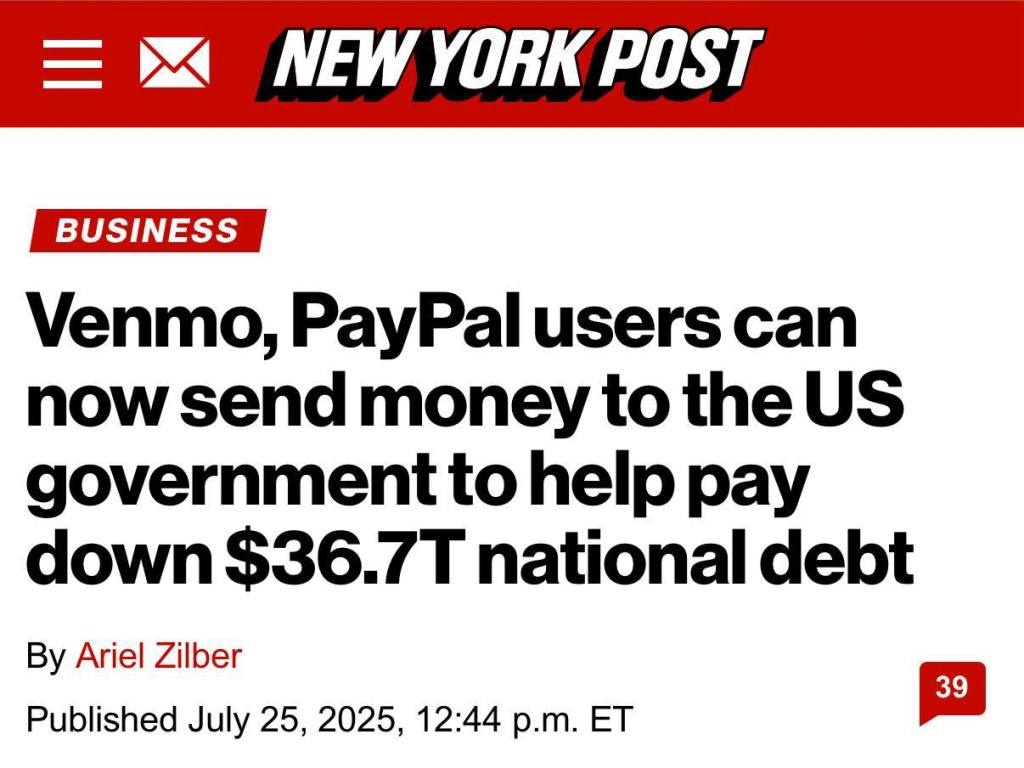
The US Treasury Department is now accepting Venmo and PayPal payments from those who want to donate money to reduce the nation’s ballooning $36.7 trillion debt.
The digital payment platforms can be used after accessing the “Gifts to Reduce the Public Debt” page on Pay.gov, NPR’s Jack Corbett noted.
The expansion of payment options comes amid growing public concern over the debt, which has surged from $19.59 trillion in 2010 to its current level, an increase of 87%, according to the Treasury Department.
The donation program has existed since 1996, with a total of $67.3 million contributed — an amount that remains negligible compared to the federal debt.

The federal government has given Americans the option of using Venmo and PayPal to help pay down the national debt.pay.gov
Critics have questioned the value of individual donations toward the national debt.
Samson Mow, CEO of Bitcoin technology firm JAN3, compared the effort to “sending Bitcoin to a burn address.”
President Donald Trump’s recently enacted “Big, Beautiful Bill” is projected to add an additional $3.4 trillion to the debt over the next decade, according to the non-partisan Congressional Budget Office.
The legislation prompted a public dispute between Trump and Tesla CEO Elon Musk, who criticized the bill for raising the debt ceiling by $5 trillion.
Despite the Treasury’s new push for public donations, the scale of the debt continues to raise questions about the sustainability of US fiscal policy and the effectiveness of such symbolic gestures.

The national debt has ballooned to a record $36.7 trillion as of Friday, according to the Treasury Department. FiscalData.Treasury.gov
Meanwhile, Bridgewater Associates founder Ray Dalio is sounding the alarm, warning that the country is at growing risk of a fiscal crisis unless urgent policy changes are made.
Dalio has repeatedly likened the mounting debt to “plaque in arteries,” cautioning that the cost of servicing the debt is “severely diminishing purchasing power.”
“We are spending 40% more than our income,” he said, adding that “we’re approaching the point where we may need to borrow just to pay the interest on our existing debt — this is the classic debt death spiral.”
According to Dalio, the US is approaching an inflection point where debt and interest obligations could crowd out essential government spending.

The donation program has existed since 1996, with a total of $67.3 million contributed. But the option to pay through Venmo and PayPal is new.
He has called on lawmakers to reduce the budget deficit from approximately 7% of GDP to 3%, a move he believes could be achieved with a mix of spending cuts and tax increases.
Dalio expressed concern over weakening investor confidence, citing falling bond sales, a weaker dollar, and rising gold and equity prices.
“Unless the budget deficit is cut to about 3% of GDP, the supply of debt will be much greater than the demand,” he warned, adding that debt service costs will “severely squeeze out the government’s ability to spend.”
While he sees a low risk of an immediate crisis, Dalio estimates that the chance of a financial “trauma” caused by a sudden loss of confidence now exceeds 50% if no action is taken.
He has urged bipartisan cooperation, stating that early intervention is “much cheaper and less painful than waiting for a tipping point.”
Dalio continues to call for “bipartisan practicality and collective sacrifice” to stabilize the fiscal trajectory before it becomes unmanageable.
A Treasury Department spokesperson referred The Post to comments made by Treasury Sec. Scott Bessent during his testimony before Congress last month.
Bessent, told lawmakers that the administration’s tax and trade policies are projected to lower the federal deficit over the next decade, despite skepticism from congressional analysts.

Treasury Secretary Scott Bessent says the administration’s trade and tax policies will reduce the federal deficit over time.
“There’s ‘varying scoring’ of the tax bill,” Bessent said during a Senate Finance Committee hearing. “It is my view that over the 10-year window, it will decrease.”
While noting his disagreement with the Congressional Budget Office’s (CBO) methodology, Bessent cited two separate estimates from the agency: one on the impact of tax cuts and the other on the effects of the president’s tariffs. He said the data shows that import duties are expected to generate $2.8 trillion in revenue over 10 years.
“Even in Washington DC math, that is a $400 billion surplus,” Bessent said.
“You can’t take one without the other,” he told Sen. Elizabeth Warren (D-Mass.), emphasizing that the CBO analyses must be considered together.

Bridgewater Associates founder Ray Dalio is sounding the alarm, warning that the country is at growing risk of a fiscal crisis.
In an interview last week with Fox Business anchor Maria Bartiromo, Bessent added that the administration had already collected nearly $100 billion in tariff revenue so far this year and is “on track for $300B this year.”
He noted that this amounts to “almost 1% of GDP.”
Bessent also pointed to recent fiscal trends as a sign of improvement.
“June delivered a budget surplus with higher revenue and lower spending,” he said.
“This is how we clean up the fiscal mess we inherited,” Bessent asserted.
Resources:
https://t.me/LauraAbolichannel/73938
https://nypost.com/2025/07/25/business/venmo-paypal-users-can-help-us-government-pay-down-36-7t-debt/