
By Jane C. Timm
The court ruled that Democrats did not follow proper procedure when they put the constitutional amendment on the ballot in April in an effort to flip four House seats.
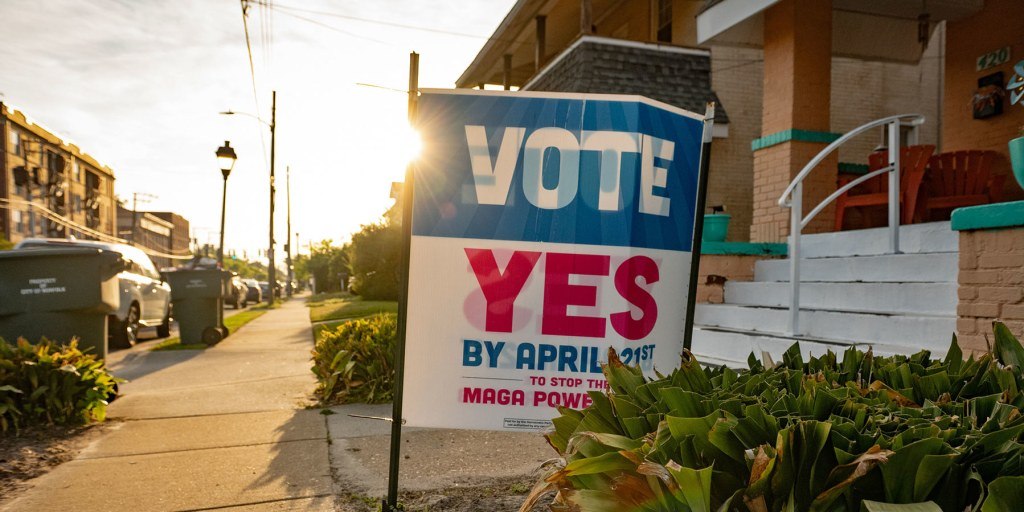
The Virginia Supreme Court on Friday blocked a new Democratic-drawn congressional map from taking effect, delivering a major boost for Republicans as they defend their narrow House majority in the midterm elections.
Weeks after Virginia narrowly approved the plan in a statewide vote, the court ruled that Democratic lawmakers did not meet the procedural requirements to place a constitutional amendment on the ballot, which was written to pave the way for the redrawn district lines. Democrats were seeking a map designed to give the party up to four new House seats.
This ruling — coupled with GOP map-drawing efforts in other states in the last year and the U.S. Supreme Court’s recent ruling overturning racial gerrymandering regulations in the Voting Rights Act — means that Republicans will head into the midterms with a clear redistricting advantage.
Where districts have changed ahead of the 2026 election
State legislators, voters and other forces have redrawn maps in eight states in the last year. Virginia’s state Supreme Court struck down a Democratic-drawn map on Friday, arguing the process to pass a constitutional amendment did not follow proper procedures.
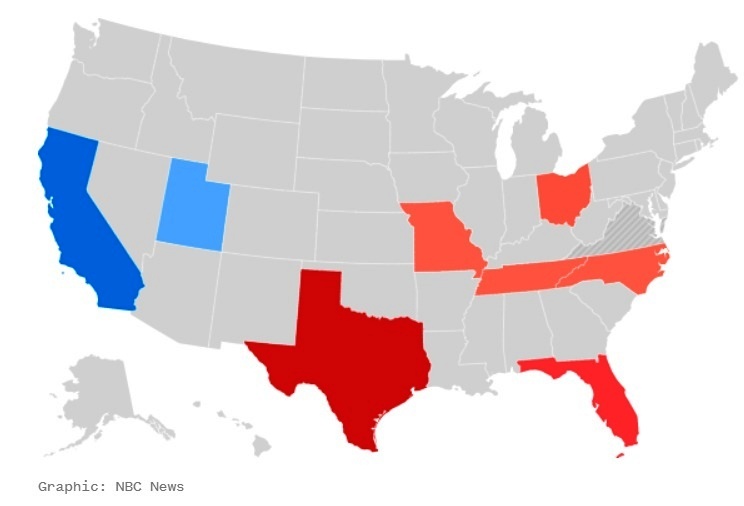
Republicans could gain as many as 14 seats from redrawn maps across six states so far, compared with six for Democrats from redrawn maps. But there could be significant variation based on the actual election results in those new districts, which are not necessarily easy wins for the party that drew them.
Democrats need a net gain of at least three House seats in November to flip the House majority.
In Virginia, the state Supreme Court concluded that the legislature began its constitutional amendment process too late to be lawful.
“This violation irreparably undermines the integrity of the resulting referendum vote and renders it null and void,” the court wrote in its order.
Lawmakers are required to pass a constitutional amendment through two consecutive legislative sessions with an election in between before placing it on the ballot. Republicans argued that the Democratic-controlled legislature first passed the amendment when early voting was already underway ahead of Virginia’s 2025 statewide elections. Democrats tried to counter by saying that Election Day itself, not the start of early voting, is the relevant date.
The state Supreme Court had previously allowed the April special election to go forward, while reserving the right to rule on the measure’s legality later on. Virginians narrowly voted in favor of the redistricting referendum by 3 points.
Virginia Democrats kick-started their multistep redistricting process last fall in response to President Donald Trump’s urging several GOP-led states to redraw their maps ahead of the battle for the narrow House majority. They needed to amend the constitution to bypass a bipartisan redistricting commission, which was approved by voters in 2020, to pass the gerrymandered map proposal. California Democrats took a similar route to enacting a new map last year that could net the party up to five seats.
Justice Arthur Kelsey criticized the state for suggesting the court could not rule on the matter after voters had approved the constitutional amendment, noting its attorneys had also argued that the court shouldn’t rule before the special election.
Democrats’ argument that early voting was not part of the intervening election was unconvincing, Kelsey wrote in the majority opinion.
“Under this thesis, early Virginia voters unknowingly forfeited their constitutionally protected opportunity to vote for or against delegates who favor or disfavor amending the Constitution by not anticipating a legislative vote on a constitutional amendment four days before the last day of voting,” the opinion said.
The special election did not come cheap: Virginia appropriated $5 million to administer the election, tens of millions of dollars were spent on advertising, and more than 3 million people cast ballots.
Virginians for Fair Maps, the group that opposed the Democrats’ redistricting referendum, celebrated the court ruling in a statement.
“Virginians spoke loud and clear in 2020 that voters should pick their elected officials, not the other way around. Today, their voices were heard over the shamefully deceptive rhetoric and language of an unconstitutional effort by Richmond Democrats to carve up the state for themselves,” said group co-chairs Jason Miyares, the Republican former state attorney general, and Eric Cantor, the Republican former U.S. House majority leader.
Trump also praised the state Supreme Court’s decision on Truth Social as a “Huge win for the Republican Party, and America.”
U.S. House Minority Leader Hakeem Jeffries, D-N.Y., said, “The decision to overturn an entire election is an unprecedented and undemocratic action that cannot stand.”
“We are exploring all options to overturn this shocking decision,” he said in a statement.
Meanwhile, Virginia House Speaker Don Scott, a Democrat and one of the leading proponents of the redistricting effort, said in a statement, “We respect the decision of the Supreme Court of Virginia.”
“This was always about more than one election — it was about whether the voices of the people matter,” he said. “And no decision can erase what Virginians made clear at the ballot box.”
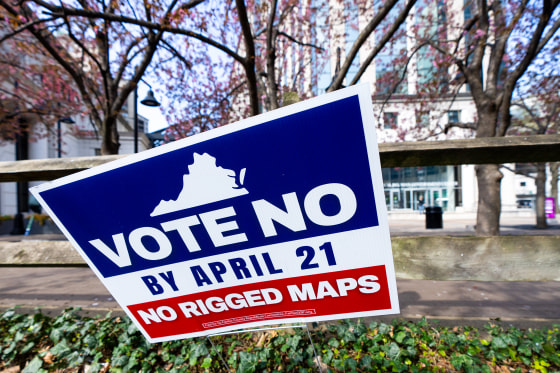
A sign urges early voters to vote no on the Virginia redistricting referendum at the Ellen M. Bozman Government Center in Arlington on March 31.
This fall’s midterm elections in Virginia will take place under the current map, where Democrats represent six of the state’s 11 congressional districts.
Original source: https://www.nbcnews.com/politics/2026-election/virginia-supreme-court-blocks-democratic-drawn-congressional-map-voter-rcna342687