
By Henry Bodkin – JERUSALEM CORRESPONDENT
Netanyahu warns deal would create ‘Hamastan’ and pledges no military withdrawal until terror group is ‘genuinely’ disarmed
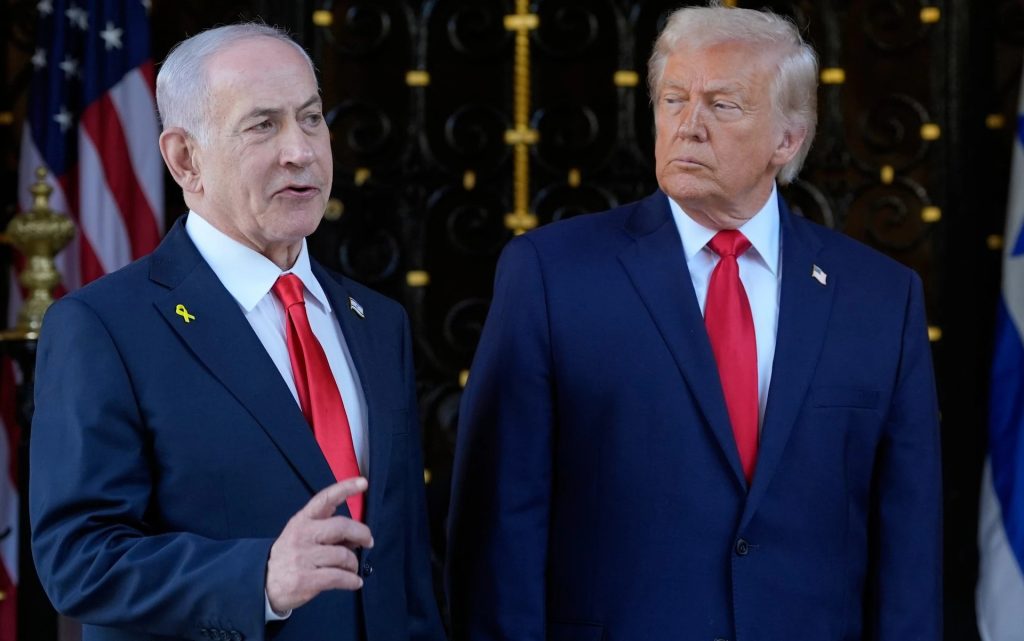
Benjamin Netanyahu has rejected Donald Trump’s peace deal in Gaza, suggesting it would turn the enclave into “Hamastan”.
At a meeting of the Israeli cabinet, he said: “Israel does not accept the 15-point document,” the first time he has explicitly refused the deal.
Mr Trump hailed the disarmament deal with Hamas, which was contingent on a stage-by-stage Israeli withdrawal, as a “historic” breakthrough when it was announced late last month.
But on Sunday Mr Netanyahu said the Israel Defence Forces (IDF) would not move until the terror group gave up all its weapons.
“The IDF will not carry out any withdrawal until Hamas is disarmed,” he said.
“And when I say the disarming of Hamas, it means heavy weaponry, lighter weaponry, all weaponry.
“And we are talking about genuine disarmament, not fictitious disarmament.”

A Palestinian child lies on a damaged mattress at the site of an Israeli strike on a house in Gaza
The public rejection of Mr Trump’s cherished diplomatic agreement risks infuriating his ally.
The relationship between the two men had already taken a knock because of frustration over the failure of the Israel-US assault on Iran to achieve its objectives, with Mr Trump publicly humiliating the Israeli prime minister on a number of occasions.
On Sunday, Mr Trump insisted that the US was still “semi-negotiating” with Iran, but would continue to apply economic pressure in the hopes of forcing negotiations.
“We are just watching Iran with its huge inflation and the fact they have no money,” the president told Axios, adding that a US naval blockade had worsened Iran’s economic crisis.
“It will work out. It always works out. It’s like a chess game,” Mr Trump said.
There are also tensions between Washington and Mr Netanyahu over the IDF presence in both southern Lebanon and Syria.
Mr Netanyahu is facing a strong challenge in the upcoming general election from Gadi Eisenkot, a former top general, and badly wants Mr Trump’s approval.
However, withdrawing from Gaza could be electorally even more damaging.
The outline deal – many of the details are yet to be negotiated – envisages a “decommissioning process” whereby Hamas hands over heavy weapons first, then inventories and maps of tunnels and weapons workshops, and finally light weapons.
They would be stored, potentially in Gaza by a Palestinian security force, rather than being handed to the IDF.
Each stage would be verified by an international committee. This would probably include delegates from Turkey and Qatar, countries Israel regards as sponsors of terror, and be contingent on the IDF withdrawing in stages from the Strip.
Mr Netanyahu said more or less the same thing last week, but in his Sunday cabinet appearance he seemed keen to highlight his defiance of Mr Trump.
“I’ve heard people saying ‘you didn’t say it’, so here I am saying it again.
“Israel does not accept the 15-point document,” he said.
He added, however, that Israel was speaking to the White House about the issue.
“They have ideas, some of which are acceptable to us and some of which are unacceptable, and we know how to stand firm on these things.”
He prefaced his remarks by saying that as long as he remained prime minister, there would be no Palestinian state, “neither Fatahstan”, a reference to the West Bank, which is controlled by the Fatah political movement, “nor Hamastan”.
Hamas publicly remains committed to the deal.

A drone strike by the Israeli army targets several buildings on Industrial Street in Gaza City
Bassem Naim, a spokesman for the group, told AFP: “We expect the mediators and the American guarantor to pressure Netanyahu and his government to adhere to the roadmap and not obstruct the process for internal political and electoral reasons.”
It was reported last week that Mr Netanyahu had dispatched one of his most trusted advisers, Ron Dermer, to Washington to attempt to reduce the fallout from the disagreement.
Known as Bibi’s brain, the former minister and Israeli ambassador to Washington had been called out of retirement on the basis he knows the American system best.
Last month’s deal was struck between Hamas and the Board of Peace, a body created by Mr Trump in the aftermath of the 20-point plan that ended the Gaza war last October. It has subsequently gained a UN Security Council mandate for its work.
Although an Israeli delegation is understood to have been in Egypt and was aware of the terms, Israel was not party to the agreement, a point which Mr Netanyahu and other Israeli officials have emphasised subsequently.
However, the Board of Peace is understood to be of the view that Israel is bound by the July framework because it falls within the scope of the 20-point plan it signed up to last year, which resulted in all the hostages coming home.
Original source: https://www.telegraph.co.uk/world-news/2026/08/09/benjamin-netanyahu-israel-donald-trump-gaza-plan-hamas/