
By Simon Jones,Chris GrahamandAndré Rhoden-Paul

Hundreds of protesters gathered in Portsmouth on Sunday night after around 140 migrants arrived in a single dinghy that had crossed the English Channel.
In the second major anti-migrant protest of the weekend, police faced off with demonstrators as they blocked roads in an effort to stop the people who had arrived on the boat from leaving the city.
Hampshire Police urged people to avoid the Eastney Landing ferry port area, where the migrants were brought ashore, and said a dispersal order was in place, meaning anyone failing to comply could be arrested.
The government condemned “the intimidating and thuggish behaviour” of the protesters, many of whom were dressed in black and wore masks.
Protesters said they were trying to stop authorities transporting the migrants to the Manston processing centre in Kent.
Police carrying riot shields protected a number of coaches parked on a road leading away from Eastney Marina as protesters blocked traffic.
Daniel Thomas, known as Danny Tommo – an associate of far-right activist Tommy Robinson – was livestreaming from the scene.
“Roads are all blocked, they are never going to be able to leave here,” he said.
A government spokesperson said: “The right to peaceful protest is fundamental to our democracy, but it must never cross a line into disorder.”
“We thank the emergency services who are working to safely manage this situation.”
The protest came after a large group of masked men held a demonstration over the small-boat crossings at the Port of Dover on Saturday, causing a major disruption.
Days earlier, Prime Minister Andy Burnham and French President Emmanuel Macron met to discuss how to “scale up” efforts to reduce small boat crossings.
In August a single small boat carrying a record 230 people successfully crossed the Channel.
Conservative MP for Isle of Wight East Joe Robertson said on X it was “extremely concerning to see an illegal migrant crossing this far west”, given boats ordinarily land near Dover.
Hampshire and Isle of Wight Police and Crime Commissioner Donna Jones told the BBC her primary concern was that Portsmouth did not become a “destination of choice for people traffickers”.
“The government has invested heavily into Dover – the operation down there… is significant in terms of the holding centre, the processing, UK Border Force,” she told BBC Radio 4’s Today programme.
“We have hundreds of miles of coastline across southern England, and if Dover is no longer the destination of choice and instead there is going to be a spread across southern England, this is a significant issue for the government.”

The protesters blocked roads near the Eastney Landing ferry port area
Reform UK leader Nigel Farage posted on X: “This week Andy Burnham struck an agreement for 45 more officers on French beaches. Today a boat launched from Baie de Seine, 170 miles from Calais, arriving on the beaches of Hampshire for the very first time. This is a joke. Only Reform will send the boats back.”
The latest dinghy launched in Bay of the Seine and was shadowed for around 10 hours by French rescue boats in case it got into difficulty. The French coastguard said it was not safe to attempt to stop the dinghy on water.
It reached UK waters at lunchtime and the people on board were met by lifeboats from Bembridge and Yarmouth.
French authorities said it was unusual for the migrant boat to depart from the area – 170 miles from where they are commonly launched near Calais – making the crossing to the UK significantly longer.

Protesters face off against the police in Portsmouth
On Saturday, hundreds of protesters, dressed in black and wearing face coverings, blocked roads near the Port of Dover and were heard chanting “stop the boats”.
A council boss said police were slow to react to the “exceptionally well organised” protest.
Kevin Mills, who leads Dover District Council, told the BBC that demonstrators “caught several agencies on the hoof” when they arrived on Saturday.
Kent Police is yet to comment, but cabinet minister Jonathan Reynolds said officers “did deal with it swiftly”.
HOPE not Hate founder Nick Lowles criticised the policing response to the protests, asking: “How can you have 300, 400 people turn up in Dover at 07:00 on a Saturday morning and the police know nothing about it?”
He told the BBC on Monday that the protests had attracted “some of the more aggressive and more violent of the far-right activists from around the country” who had taken part in similar action in recent years, and said the government should go further in condemning them.
“We need to call these people out for their politics, and for the type of Britain that they want to see.”
Last year local officials told the BBC there has been an increase in people trying to depart from Normandy.
A Home Office spokesperson said on Sunday: “This government is bearing down on dangerous small boat crossings and restoring control at our border.
“Joint efforts have seen over 48,000 crossing attempts prevented and 1,100 boats and engines seized since the election.”
They added: “But we must go further, which is why we have signed a payment-by-results deal with the French to put 40% more boots on the ground on French beaches.”
A Maritime and Coastguard Agency spokesperson said: “In response to a report on September 6 of a small boat heading towards the Hampshire coast, HM Coastguard sent lifeboats, an HM Coastguard helicopter, an HM Coastguard aeroplane and HM Coastguard Rescue Teams.
“Border Force, Border Security Command, Hampshire Police and South Central Ambulance Service were also sent.”
See the questions below:
How many people cross the English Channel in small boats?
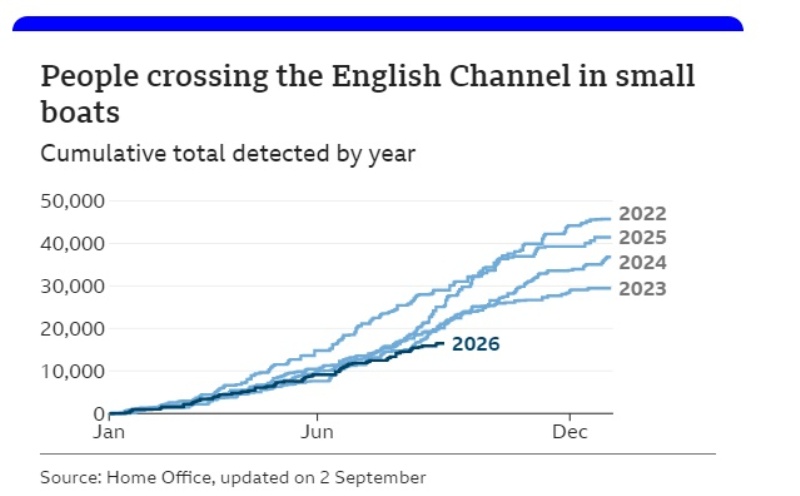
Between 1 January and 1 September 2026, a total of 16,513 people crossed the English Channel by small boat from France. This was down by 43% on the same period the previous year.
These crossings have become the most common way for people to be detected entering the UK illegally since 2020.
Nearly all those who arrive by small boat claim asylum. Under international law, this means they are allowed to stay in the country while their asylum application is considered.
Small boat arrivals made up 40% of asylum applications between July 2025 to June 2026.
Boats that arrived in the UK from 2 September 2025 to 1 September 2026 carried an average of 68 people. This has more than doubled since 2021.
Experts say overcrowding in boats makes crossings riskier. At least 84 people died while attempting to cross the Channel in 2024, according to the United Nations (UN).
When looking at the scale of small boats crossings, the number of these arrivals is about 5% of the size of total immigration into the UK from January 2025 to December 2025.
The government has pledged to “smash the gangs” behind these crossings in order to reduce the numbers.
Who is arriving in the UK on small boats?
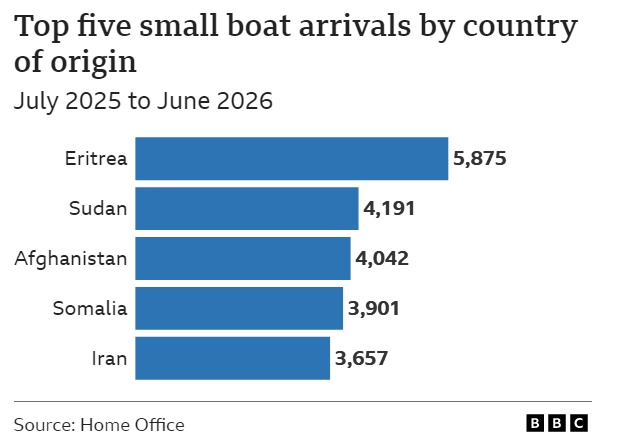
People from Eritrea accounted for 18% of all arrivals from July 2025 to June 2026.
In the latest figures covering January 2025 to December 2025, at least 2,335 people who arrived by small boat were found to be potential victims of human trafficking or other forms of modern slavery, according to the Home Office.
How else do people stay in the UK without permission?
There are also individuals who arrive legally, for example via a work or study visa, and then overstay their limit.
The total number of people who live in the UK illegally after arriving legally is not known.
In bilateral talks on Thursday, Burnham and Macron agreed they were making headway in reducing small boat crossings in the English Channel but now needed to go further.
Original source: https://www.bbc.com/news/articles/clyegwl9vzqo