
By Steve Holland, Parisa Hafezi, Enas Alashray and Ahmed Tolba
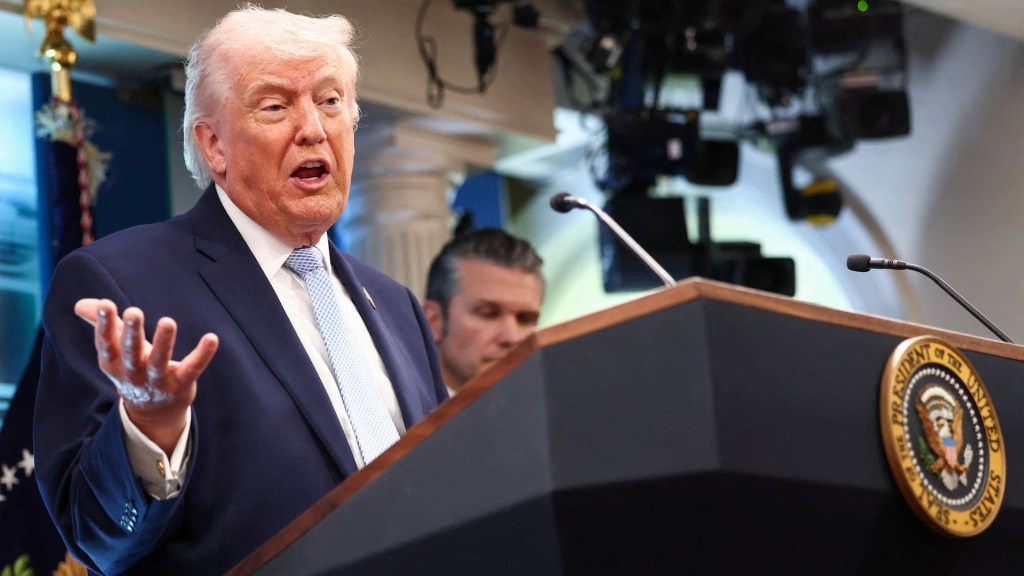
- Trump says Iran proposal is basis for negotiation
- Iran describes deal as victory over Trump
- Several Gulf countries report Iran missile and drone attacks
- Trump’s earlier threat draws international condemnation
WASHINGTON/DUBAI/CAIRO, April 7 (Reuters) – U.S. President Donald Trump agreed to a two-week ceasefire with Iran on Tuesday, less than two hours before his deadline for Tehran to reopen the Strait of
Hormuz or face devastating attacks on its civilian infrastructure.
Trump’s announcement on social media represented an abrupt turnaround from earlier in the day, when he issued an extraordinary warning that “a whole civilization will die tonight” if his demands were not met.
Pakistan Prime Minister Shehbaz Sharif, who helped mediate the ceasefire, said in a post on X that he had invited Iranian and U.S. delegations to meet in Islamabad on Friday.
Trump said the last-minute deal was subject to Iran’s agreement to pause its blockade of oil and gas supplies through the strait, which typically handles about one-fifth of global oil shipments. Iran’s foreign
minister, Abbas Araqchi, said in a statement that Tehran would stop counter-attacks and provide safe passage through the waterway.
“This will be a double sided CEASEFIRE!” Trump wrote on his Truth Social platform. “The reason for doing so is that we have already met and exceeded all Military objectives, and are very far along with a
definitive Agreement concerning Longterm PEACE with Iran, and PEACE in the Middle East.”
Iran’s Supreme National Security Council portrayed the deal as a victory over the U.S., claiming Trump had accepted Iran’s conditions for ending hostilities.
In response, White House press secretary Karoline Leavitt said: “This is a victory for the United States that President Trump and our incredible military made happen.”
“The success of our military created maximum leverage, allowing President Trump and the team to engage in tough negotiations that have now created an opening for a diplomatic solution and long-term
peace,” she said in a post on X.
The war, now in its sixth week, has claimed more than 5,000 lives in nearly a dozen countries, including more than 1,600 civilians in Iran, according to tallies from government sources and human rights
groups.
A source briefed on the talks expressed wariness about the two-week ceasefire holding, saying the U.S. side believed Iran might be trying to buy time. It was a “trust-building exercise,” the source said.
CONDITIONED ON STRAIT’S REOPENING
Two White House officials confirmed that Israel has also agreed to the two-week ceasefire and to suspend its bombing campaign on Iran. The agreement includes a cessation of Israel’s campaign in
Lebanon, Sharif said.
It was not immediately clear how soon the ceasefire would take full effect. Israeli media reported it would begin once Iran reopened the strait and that Israel expected Iranian attacks to continue in the
interim.

People wave flags as they gather after a two-week ceasefire in the Iran war was announced, in Tehran, Iran, April 8, 2026.


People gather after a two-week ceasefire in the Iran war was announced, in Tehran, Iran, April 8, 2026.

A woman reacts as people gather after a two-week ceasefire in the Iran war was announced, in Tehran, Iran, April 8, 2026.

People gather after a two-week ceasefire in the Iran war was announced, in Tehran, Iran, April 8, 2026.


Demonstrators protest against military action in Iran after U.S. President Donald Trump said that he had agreed to a two-week ceasefire with Iran, less than two hours before his deadline for Tehran to reopen the Strait of Hormuz or face widespread attacks on its civilian infrastructure, outside the White House in Washington, D.C., U.S., April 7, 2026.

An Iranian flag lies amidst the rubble of a building of the Sharif University of Technology, which was damaged in a strike, amid the U.S.-Israeli conflict with Iran, in Tehran, Iran, April 7, 2026.

A mosque at Sharif University of Technology, which was damaged in a strike, amid the U.S.-Israeli conflict with Iran, in Tehran, Iran, April 7, 2026.

A man carries an Iranian flag as he walks amidst the rubble of a building of the Sharif University of Technology, which was damaged in a strike, amid the U.S.-Israeli conflict with Iran, in Tehran, Iran, April 7, 2026.
Iraq’s Islamic Resistance said it would suspend operations in Iraq and across the region for two weeks.
More than an hour after Trump’s announcement, the Israeli military said it had identified missiles launched from Iran, and explosions from intercepted missiles could be heard in Tel Aviv. Gulf countries including Kuwait, Bahrain, Saudi Arabia and the United Arab Emirates also issued near-simultaneous alerts and activated air defences.
Israeli first responders were providing medical treatment to two 15-year-old males who were in mild condition after blast injuries in the southern town of Tel Sheva, according to a spokesperson from the MDA ambulance service.
Israeli media said its military was striking back at launch sites in Iran.
Trump, who has issued a series of threats in recent weeks only to back away, said progress between the two sides had prompted him to agree to the ceasefire. He said Iran had presented a 10-point
proposal that was a “workable basis” for negotiations and that he expected an agreement to be “finalised and consummated” during the two-week window.
Markets breathed a sigh of relief, with U.S. stock futures rising in the minutes following Trump’s message. Oil prices fell sharply, with U.S. crude futures touching their lowest price since March 26.
Global leaders also welcomed the ceasefire with the Australian government saying that “the longer the war goes on, the more significant the impact on the global economy will be, and the greater the
human cost”.
ABRUPT TURNAROUND
Trump’s announcement capped a whirlwind day that was dominated by his threat to destroy every bridge and power plant in Iran unless Tehran reopened the strait. That unnerved world leaders, rattled global financial and energy markets and drew widespread condemnation, including criticism from the head of the United Nations and Pope Leo.
Some international law experts have said attacking civilian infrastructure indiscriminately could constitute a war crime.
The closure of the strait has sharply increased oil prices, escalating the chances of a global economic downturn or even recession. The U.S. Energy Information Administration earlier on Tuesday warned that fuel prices could continue to rise for months even after the strait reopened.
With the U.S. midterm election campaign ramping up, Trump’s approval ratings have hit their lowest level ever, leaving his Republican Party at risk of losing its narrow majorities in Congress. Polls show sizable majorities of Americans are opposed to the war and frustrated by the rising cost of gasoline.
As the clock ticked down to Trump’s 8 p.m. EDT (0000 GMT) deadline, U.S. and Israeli strikes on Iran had intensified, hitting railway and road bridges, an airport and a petrochemical plant. U.S. forces attacked targets on Kharg Island, home to Iran’s main oil export terminal.
Original source: https://www.reuters.com/world/asia-pacific/iran-defiant-eve-trumps-ceasefire-deadline-2026-04-07/